Notes storage
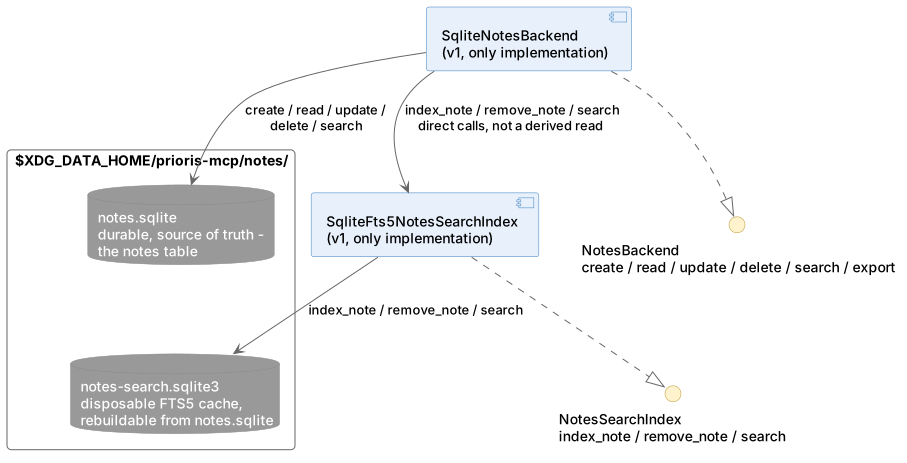
v2 — see SRS overview → Scope and Architecture → NotesBackend for why this is a new abstraction, not an extension of StorageBackend.
Purpose
The prioris client plugin currently keeps user-authored paper notes (discussion synthesis, open questions, quiz recaps) in local Markdown files under .prioris/discussions/, entirely outside prioris-mcp — see issue #13. NotesBackend is the server-side store those notes move to: identity-addressed and mutable, the opposite of StorageBackend's content-addressed, write-once fetched content.
v2 scope is single-user only, mirroring how StorageBackend itself started local-only in v1: no user_id column, one notes store per PriorisMCP instance. Multi-user/hosted deployment — the same local/hosted split StorageBackend already documents for itself (see Storage → Embedded SQLite vs. a client-server database) — is explicit future work, not designed here.
NotesBackend
Interface
| Operation | Description |
|---|---|
create |
Persist a new note, keyed by (provider, canonical_identifier, format); generates its id and timestamps. |
read |
Retrieve a single note by id. |
update |
Partially edit an existing note's text/anchors/tags/metadata in place; provider/canonical_identifier/format/author_name are immutable after creation — changing "which document/who" is a new note, not an edit. |
delete |
Remove a note by id. |
search |
Search/list notes by any combination of provider/identifier/format/date range/keyword/author/tags, paginated; no filters at all is "list everything" — see Architecture → Listing is search with no filters. |
export |
Return one note's file representation (suggested_filename, frontmatter, markdown_body) for the caller to write to disk itself — exposed as a resource, not a tool, see Architecture → Export is a resource, not a tool. |
canonical_identifier must already be resolved/pinned by the time it reaches NotesBackend, mirroring Storage → Identifier canonicalisation — resolution is the calling tool's job, not NotesBackend's, the same split StorageBackend already has with resolve_identifier. When format is omitted (a note predating any fetch), resolution is skipped entirely and the given identifier is stored as-is: there is no persisted artefact whose storage-key stability this needs to protect yet.
Data model
A given (provider, canonical_identifier, format) can have any number of notes over time — each its own row/id — not one evolving blob per document.
| Column | Type | Meaning |
|---|---|---|
id |
TEXT (UUID) | Primary key; also the export filename stem. |
provider |
TEXT | e.g. arxiv, europepmc, localfile. |
canonical_identifier |
TEXT | Pinned/resolved identifier — never a bare unversioned one. |
format |
TEXT, nullable | Nullable because a note can predate any fetch (e.g. "want to read this"). |
text |
TEXT | Free-form Markdown — the note itself. The only column indexed by keyword search. |
anchors |
TEXT (JSON array of Anchor), default [] |
Unresolved, unenforced positional hints — see below. Excluded from keyword search. |
author_name |
TEXT, nullable | NULL means "self." A plain display label, not an identity/auth concept — doesn't imply multi-user support (see Purpose above); exists so e.g. a student and their supervisor can distinguish whose note is whose on a shared local store. |
tags |
TEXT (JSON array of str), default [] |
Exact-match filterable (see search below), not keyword-indexed. |
metadata |
TEXT (JSON object, dict[str, str]), nullable |
Caller-owned, opaque scratch space — see below. |
created_at / updated_at |
TIMESTAMP | ISO 8601. |
anchors: unresolved positional hints, not pointers
Borrows shape from the W3C Web Annotation Data Model's selector concept (TextQuoteSelector's exact/prefix/suffix, adapted here as exact_text_quote/prefix_context/suffix_context) without adopting it as a formal dependency — page_number/section_heading/paragraph_index are this project's own addition, not a standard W3C selector type.
class AnchorLocation(BaseModel):
    page_number: int | None = None
    section_heading: str | None = None
    paragraph_index: int | None = None

class AnchorSelectors(BaseModel):
    exact_text_quote: str | None = None
    prefix_context: str | None = None
    suffix_context: str | None = None

class Anchor(BaseModel):
    location: AnchorLocation | None = None
    selectors: AnchorSelectors | None = None
None of this is validated or resolved against manifest.sqlite — no coupling to spans, no re-parse drift to handle, consistent with Architecture → Anchoring. It exists purely so a human (or an agent acting on explicit user input) can leave a precise-enough breadcrumb to relocate a passage by eye later. The one validation enforced at write time: an Anchor entry with both location and selectors absent (or all-null within them) is rejected — a fully-empty entry carries no information.
anchors is intentionally excluded from keyword search (see Storage layout below) — mixing positional text like "page 4" into a keyword/semantic search index would pollute relevance ranking with information that has nothing to do with a note's actual content.
author_name, tags, metadata
author_namedefaultNULLmeans "self," to avoid writing a literal"self"/"me"value on the overwhelming majority of notes. This makes "notes I wrote" and "no author filter at all" two different queries (author_name IS NULLvs. no predicate at all), not the same one — a plain nullable field can't express that distinction unambiguously on its own; seesearchis structured filtering plus optional keyword matching below for the tri-state that actually expresses it.tagsis a plain, exact-match label system (JSON array, same "list even though the common case is small" precedentmanifest.sqlite's ownspanscolumn already sets), not keyword-indexed. Filtering combines three explicit list parameters (must-have-all / must-have-any / must-have-none) rather than a general boolean query grammar; the latter is a materially bigger feature (a parser or structured nested-filter object, its own combinatorial test coverage) not justified at this store's expected scale.metadatais caller-owned, opaque scratch space, modelled on Stripe's/GitHub'smetadatafields:NotesBackendpersists and returns it verbatim, never interprets, validates, or searches it. Values are plain strings; a caller wanting structured data JSON-encodes it into the string value themselves. Deliberately not filterable viasearch— if some key turns out to matter enough to filter/search by, that's the signal it should graduate to a real, typed, indexed column (the waytags/author_namealready are), not stay in the opaque bag.
search is structured filtering plus optional keyword matching
Every filter except keyword (provider, canonical_identifier, format, a date range, an author filter, and the three tag-membership lists) is a plain structured predicate against notes.sqlite. The author filter is a tri-state, not a nullable string — ANY (no author filtering), MINE (author_name IS NULL), or NAMED (author_name = <value>) — for the same reason author_name's own NULL-means-self default needs one: a single nullable parameter can't distinguish "no filter" from "filter to a null author." Results are paginated (offset/limit, total count, has_more), mirroring the shape Non-functional requirements → Response size already establishes for parse_full_text, and default-ordered created_at DESC (most recent first) when no keyword is given; a keyword search orders by relevance instead.
canonical_identifier given without provider is rejected (invalid_request) rather than silently searched across every provider. search performs no resolution of its own — by the time a value reaches it, canonical_identifier is just a plain equality predicate against a stored column (see NotesBackend above), not something search can disambiguate. Canonical identifiers are only unique within a provider's own scheme (arXiv's 2601.05525v2 shape, Europe PMC's, the local filesystem source's server-minted YYYYMMDD-HHmm-XXXX — see Interface specification → research_notes_create), not guaranteed unique globally across providers; requiring provider alongside it closes that (currently theoretical, given how distinct those three shapes are) cross-provider collision rather than relying on it never happening.
Storage layout
New sibling root, $XDG_DATA_HOME/prioris-mcp/notes/, next to downloads/ (not inside it — notes are user-authored, not fetched content, and downloads/ is purpose-built for the latter, per Storage → Purpose). Configured by a new EnvVars entry (PRIORIS_MCP_NOTES_DIR), the same env-var-driven pattern PRIORIS_MCP_STORAGE_DIR already uses.
$XDG_DATA_HOME/prioris-mcp/notes/
  notes.sqlite            durable, source of truth — the `notes` table above
  notes-search.sqlite3    disposable FTS5 cache, rebuildable from notes.sqlite
notes-search.sqlite3 is deliberately minimal — a departure from search.sqlite3's precedent
notes-search.sqlite3's FTS5 table holds just a note id (UNINDEXED) and tokenized text, not the denormalized provider/identifier/format columns search.sqlite3 carries — see ADR-00013: notes-search.sqlite3 is deliberately minimal, not denormalized like search.sqlite3 for why. search applies every structured predicate directly against notes.sqlite; only if a keyword is given does it additionally intersect with the note ids matching notes-search.sqlite3.
Concurrency and the embedded-vs.-hosted story are identical to StorageBackend's existing treatment — see Storage → Embedded SQLite vs. a client-server database — and aren't re-derived here.
Export
export returns {suggested_filename, frontmatter, markdown_body} for exactly one note — one file per note, not one file per document — see ADR-00014: Notes export is one file per note, not one file per document for why.
frontmatter carries every non-text column verbatim — id, provider, canonical_identifier, format, anchors, author_name, tags, metadata, created_at, updated_at — as a plain JSON object (see Interface specification → Notes), not pre-rendered YAML text: the caller renders it into whatever frontmatter dialect its target tool expects (YAML for an Obsidian vault or any other Markdown-plus-frontmatter tool, tags as native tags and the rest as queryable properties) when it writes the file. markdown_body is exactly the note's own text column, unmodified. See Architecture → Export is a resource, not a tool for why the server itself never writes this to disk.
Future: cross-document notes and relations
Not designed here, and explicitly out of scope for v2 (see SRS overview → Out of scope for v2): every v2 note has exactly one primary document (provider/canonical_identifier/format, immutable — see NotesBackend above). A note observing something about other documents beyond that primary one — e.g. while reading and annotating one paper, also noting that several other papers handle the same problem differently — is only expressible today as free text inside text itself, with no structured, queryable granularity to it.
This is about capturing a relationship a human has already declared while writing a note — no discovery/inference involved.
The intended future direction is additive to the v2 design above, not a redesign of it: a new table (e.g. note_document_relations, keyed by note_id plus a secondary document's own provider/canonical_identifier/format) sitting alongside a note's existing primary-document identity, not replacing it. Each row would carry a structured DocumentNotesRelation rather than a plain relation string, to capture richer relation information (e.g. a relation type/label alongside free-text description) than a single opaque string could — its exact shape isn't designed yet. Because a note's primary document stays exactly as specified above, none of create/read/update/delete/search/export's current contracts need to change to add this later; it would land as new, optional surface area (a new tool or two, an additive export frontmatter key) rather than a breaking change to what v2 already ships.