Security
This page covers security requirements — another cross-cutting quality alongside Non-functional requirements, but broken out into its own page rather than folded in there, since v1's security surface is concrete enough (and distinct enough in kind from concurrency) to warrant its own visibility rather than being one subsection among others.
v1 targets unauthenticated, open-access providers only (see SRS overview → Scope), so this page is not about authentication or credential handling — it's about the concrete risks that exist even without any auth: an MCP client-supplied identifier driving an outbound network request, and externally-sourced content flowing into a parser.
Untrusted identifiers must not drive unconstrained outbound requests
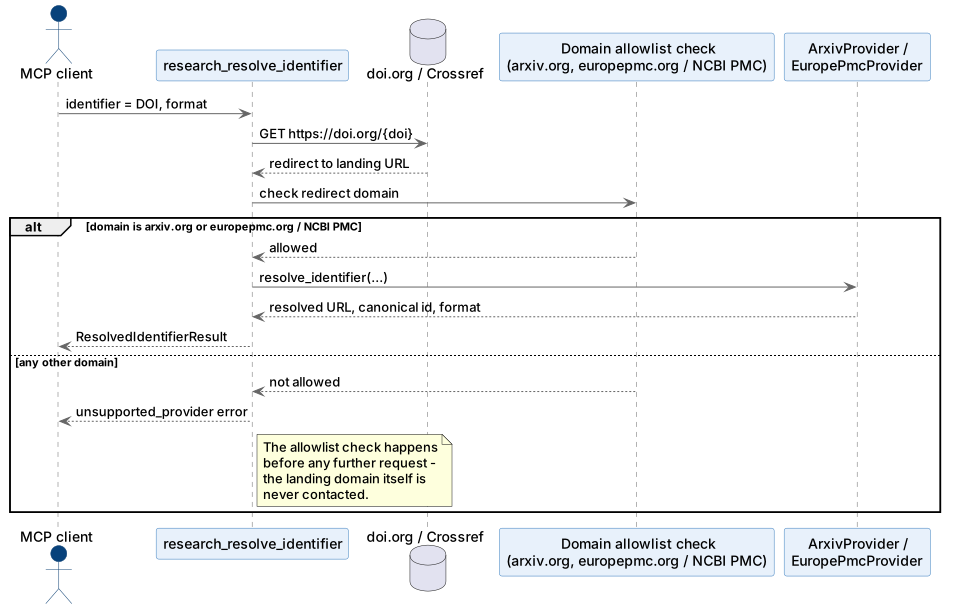
The domain check happens between the DOI redirect and any further request — not after an attempt to use the landing page. research_resolve_identifier follows the doi.org/Crossref redirect to find out which domain a DOI actually points at, then checks that domain against the allowlist (arxiv.org, europepmc.org/NCBI PMC) before doing anything else with it. Only an allowed domain ever reaches the provider handoff shown on the left branch above; a disallowed domain fails immediately with unsupported_provider, on the right branch, with no request ever issued to that landing page — the allowlist is what a caller-supplied identifier can drive PriorisMCP's own network egress to, not merely which content ends up served back to the caller.
Architecture → Identifier routing already requires DOI resolution to fail with an "unsupported provider" error rather than fall back to scraping an arbitrary landing page — that decision was made for terms-of-use reasons, but it also happens to be a security boundary: research_resolve_identifier takes a caller-supplied identifier and, for a DOI, follows a redirect (via doi.org/Crossref) to a URL it does not control in advance.
This must be implemented as a strict allowlist on the resulting domain (arxiv.org, europepmc.org/NCBI PMC) checked before any further request is made against it, not as "fetch the landing page, then decide what to do with it." A caller-influenced identifier must never be able to cause PriorisMCP to issue a request to an arbitrary host — including internal/private network addresses — as a side effect of resolution. The existing functional requirement (fail closed with "unsupported provider") already produces the right behaviour; this page states the security rationale for why that must hold even if the functional requirement is later relaxed (e.g. to add a new supported provider) — any addition must extend the allowlist deliberately, not open resolution up to whatever a redirect happens to return.
Local filesystem access means access to the caller's own content, not the server's disk
research_localfile_fetch_full_text takes the caller's file content, base64-encoded (content_base64), rather than a server-side path — see ADR-00028 for why an earlier path-based design was rejected once streamable-http/http transport made "local" ambiguous between client and server filesystems. This removes the path-containment problem entirely rather than hardening it further: there is no server-side path to resolve, so there is nothing for a .. segment or a symlink to escape. The remaining risk this design surface has is bounding how much content a caller can send and validating what it actually is, both covered below under Fetched content is untrusted input to parse_full_text — the same shape of validation any caller-sent payload needs, independent of how it arrived.
Fetched content is untrusted input to parse_full_text
Full text persisted by fetch_full_text originates from external sources and is later fed into parse_full_text. Even though v1's providers (arXiv, Europe PMC) are trusted in the sense of being deliberately chosen, documented APIs, the documents they serve are third-party content (uploaded by their own authors/publishers) that PriorisMCP does not control the shape of.
This applies equally to the local filesystem source, even though its content never crosses the network: caller-sent bytes are still content PriorisMCP did not produce and cannot assume the shape of — it could be a genuine PDF, a mislabelled file of some other type, or a deliberately pathological one. research_localfile_fetch_full_text must therefore, before persisting anything:
- Sniff the actual format from decoded content, not any filename hint. The optional
filenameparameter (if the caller sends one) is stored only for the caller's own reference and never trusted for validation — the decoded bytes must be validated as a PDF by their content (e.g. leading magic bytes) before being written to storage, and rejected with a typed error otherwise. - Enforce a maximum decoded size before persisting it — a configurable limit (
PRIORIS_MCP_LOCAL_FILE_MAX_SIZE_BYTES, default 10MB, sized to what the PDF parser backend can reasonably process — see Non-functional requirements → Dependency selection). Because the input arrives base64-encoded, this is enforced twice: first against the encoded length before decoding anything (base64 has fixed, standard overhead — encoded length is4 * ceil(n / 3)fornraw bytes — so an oversized payload can be rejected without ever materialising more than the configured cap), then again against the decoded length, since the encoded-length bound only pins the worst case to the nearest multiple of 3 bytes. - Chunked upload doesn't reintroduce server-side path resolution.
research_localfile_begin_upload/research_localfile_upload_chunk/research_localfile_finalize_uploadstill only ever receive caller-sent bytes (per chunk), never a path — the session-based flow changes how many calls it takes to submit the content, not what is submitted. - Concurrent-session and chunk-size caps bound resource exhaustion, not just total decoded size:
PRIORIS_MCP_LOCAL_FILE_UPLOAD_MAX_CONCURRENT_SESSIONSbounds worst-case buffered memory across all in-progress uploads between TTL sweeps, andPRIORIS_MCP_LOCAL_FILE_UPLOAD_MAX_CHUNK_BYTESrejects an oversized single chunk before it's ever appended to a session's buffer. - Magic-byte/size validation is unchanged for the chunked path — it runs once, at
finalize_upload, over the fully reassembled content, via the same_validate_and_persistcode pathresearch_localfile_fetch_full_textuses (not a separate, potentially divergent check).
Both checks happen before write, so rejected content never reaches storage at all — consistent with parse_full_text's own bounded-failure requirement below, which still applies in full once local-file content has been persisted and is handed to the same PDF parser backend arXiv's full text already goes through.
parse_full_text must treat this content as untrusted input: malformed, unusually large, or pathological documents (e.g. a PDF crafted to be maximally expensive to parse) must fail as a bounded, typed error rather than crash the server process or hang it indefinitely. This is a robustness requirement on the parsing path specifically, distinct from the general error-handling already described for missing content in Architecture → parse_full_text.
A bounded per-call failure is not sufficient on its own
The JATS-XML-to-Markdown path (JatsXsltMarkdownBackend in src/prioris_mcp/parsers/jats_xslt.py) runs its XSLT transform in a worker thread and enforces the bound above by abandoning that thread if it overruns the deadline, rather than waiting for it — Python offers no way to forcibly stop a thread already running native (libxslt) code, and abandoning it is what lets the calling parse_full_text invocation still fail cleanly at the bound instead of hanging past it. The abandoned thread itself keeps running to completion in the background, consuming a CPU core and holding its partially-built result tree in memory for however long the pathological document actually takes — which is unbounded.
A single such call is harmless. But nothing in a per-call bound stops repeated calls — against pathological documents, arriving faster than each one naturally finishes — from accumulating unboundedly many of these abandoned-but-still-running transforms concurrently, each holding a CPU core and memory: an aggregate resource-exhaustion risk distinct from, and not closed by, the per-call timeout above.
This must be closed by bounding how many JATS transforms are ever actually executing at once, independent of how many parse_full_text calls have been made or abandoned: a fixed-size gate held for a transform's true lifetime (acquired before the CPU-bound work starts, released only when it actually finishes, in a finally), not one tied to the calling task's own cancellation — see ADR-00029 for why anyio's built-in to_thread.run_sync(limiter=...) doesn't actually provide this bound. Calls beyond the cap block waiting for a slot rather than starting a new transform outright, and are themselves still subject to the same per-call bound above — so a caller that can't acquire a slot in time still fails as a clean, typed error rather than queuing indefinitely.
The cap (PRIORIS_MCP_JATS_MAX_CONCURRENT_TRANSFORMS — see Configuration) is configurable, but is capped at the host's CPU count regardless of configuration: this is CPU-bound native work, so oversubscribing beyond available cores only makes the worst case worse without any offsetting throughput benefit.
Extracted PDF image resources must not leak filesystem paths
Storage → Future: extracted PDF images exposes each extracted image as its own MCP resource once PRIORIS_MCP_PDF_EXTRACT_IMAGES is enabled. That resource's URI scheme is not yet decided, but is bound by the same principle already established in Local filesystem access means access to the caller's own content, not the server's disk: the URI/handler must identify an image by its logical identity (provider, item identifier, image ID) and resolve it against the storage abstraction internally, never by embedding or accepting a server-side filesystem path directly. This isn't a new risk this feature introduces — it's the same no-server-side-path-reads constraint every other resource in this design already satisfies, stated here so it isn't overlooked when the URI scheme is actually chosen.
OCR language data is a network dependency of parse_full_text
LiteParsePdfBackend (src/prioris_mcp/parsers/pdf_liteparse.py) can invoke liteparse's bundled Tesseract OCR engine for scanned/image-only PDFs. Tesseract's own OCR needs per-language .traineddata files, which — left unconfigured — auto-download to a local cache directory on first use. That default is a hidden network dependency of a supposedly local parsing step: in an airgapped deployment, the first scanned PDF that needs OCR either fails outright or hangs until PDF_PARSE_TIMEOUT_SECONDS trips, surfacing as a generic ParseError rather than a clear configuration error.
This is made explicit and configurable rather than left to liteparse's own defaults — see Configuration:
PRIORIS_MCP_PDF_OCR_ENABLEDlets an operator disable OCR outright, accepting degraded quality on scanned PDFs in exchange for removing the dependency entirely.PRIORIS_MCP_PDF_OCR_TESSDATA_PATH(falling back to the conventionalTESSDATA_PREFIXif unset) points at a pre-populated directory of.traineddatafiles, so an airgapped operator supplies them out-of-band instead of relying on a lazy download — see Configuration → obtaining.traineddatafiles for where to get them before cutting off network access.PRIORIS_MCP_PDF_OCR_SERVER_URL/PRIORIS_MCP_PDF_OCR_SERVER_HEADERSroute OCR to an external server instead of the bundled engine, for deployments that already run one.
None of these change the bounded-failure requirement above — a misconfigured or unreachable OCR path still fails within PDF_PARSE_TIMEOUT_SECONDS rather than hanging indefinitely — they only make the underlying network dependency an explicit, operator-controlled choice instead of a silent default.
URL-based fetching is explicitly deferred, not silently assumed
The local filesystem source was considered for direct URL fetching too — letting a caller hand it a URL already reachable through the user's own out-of-band authentication (e.g. a paywalled paper's direct link, after logging in through a browser) — but this is explicitly out of scope for v1 (see SRS overview → Out of scope), stated here so it isn't mistaken for an oversight later.
The reason is the same shape of risk Untrusted identifiers must not drive unconstrained outbound requests already closes for research_resolve_identifier: a tool that fetches a caller-supplied URL lets an MCP client direct PriorisMCP's own network egress at an arbitrary host, including internal/private network addresses (SSRF), as a side effect of what looks like a content-retrieval request. Unlike the DOI case, no domain allowlist is available here — the entire premise is supporting arbitrary publisher domains the user has their own access to, which is precisely the set of hosts an allowlist would need to exclude to be meaningful. Adding this later would need its own security design (e.g. private-IP-range blocking, redirect re-validation against the same blocklist, scheme restriction to https) written and reviewed before the capability exists, not assumed to fall out of the local-file design above.
Authenticated sources are explicitly deferred, not silently assumed
Credential/secret handling for authenticated sources (e.g. Semantic Scholar) is out of scope for v1 (see SRS overview → Out of scope for v1). This page notes it explicitly so it isn't forgotten: adding an authenticated provider later will need its own security requirements (credential storage, no secrets in logs or cached responses, per-source scoping) written before that provider is built, not assumed to fall out of the existing unauthenticated design.
PriorisMCP's own HTTP ingress surface
Everything above concerns PriorisMCP calling out to arXiv/Europe PMC. v1 also serves its own MCP interface over streamable-http/http (PRIORIS_MCP_TRANSPORT, alongside stdio — see SRS overview → Scope), which has an inbound surface of its own, distinct from anything above:
- No authentication/authorization on the HTTP transport in v1. Same principle as Authenticated sources are explicitly deferred above, applied to PriorisMCP's own ingress rather than the sources it queries: v1 assumes the HTTP transport runs within a trusted local/network context — an agent invoking PriorisMCP over
stdiois the primary expected path — not exposed to the public internet. Real authentication is future work, stated explicitly so it isn't mistaken for an oversight. - Default bind address is loopback, and must stay that way.
PRIORIS_MCP_HOSTalready defaults tolocalhost(seesrc/prioris_mcp/__init__.py); binding a wider interface is a deliberate operator override via that same variable, never the shipped default. - CORS defaults to localhost origins, not the wildcard.
PRIORIS_MCP_ASGI_CORS_ALLOWED_ORIGINSdefaults to["http://localhost", "http://127.0.0.1"](seesrc/prioris_mcp/__init__.py), not["*"]. A wildcard CORS origin means any webpage's JavaScript — regardless of that page's own origin — can read this server's responses if it can reach it over the network; CORS is what makes the response readable to the page's script, not a network-reachability control. Restricting the default to explicit localhost-family origins closes this off for arbitrary/attacker origins while still allowing legitimate locally-served tools once their specific origin is added. The wildcard remains available as an explicit override for tools that don't fit a fixed localhost-origin allowlist (e.g. the MCP Inspector, which currently requires it) — that must be a deliberate operator choice made via the environment variable before launching such a tool, not the out-of-the-box behaviour.
Egress through a organisational HTTPS-inspecting proxy
The outbound requests described above (Untrusted identifiers, and the arXiv/Europe PMC fetches behind fetch_metadata/fetch_full_text) all go through the single httpx.AsyncClient shared across providers (see PriorisMCP.__init__ in src/prioris_mcp/server.py). Operators running PriorisMCP behind a organisational HTTPS-inspecting proxy — one that terminates TLS with its own, typically self-signed, certificate authority — need two things from that client, both of which httpx already provides without any PriorisMCP-specific code:
- Proxy routing.
httpx.AsyncClientdefaults totrust_env=True, so it already honours the standardHTTP_PROXY,HTTPS_PROXY, andNO_PROXYenvironment variables for routing outbound requests through a proxy. - Trusting the proxy's CA. Since
verify=True(the default — see below) uses Python's default SSL context, setting the standardSSL_CERT_FILE(a single PEM bundle) orSSL_CERT_DIR(a directory of certificates) environment variable to include the proxy's root CA is sufficient for outbound HTTPS requests to be verified against it, the same as any other trusted CA.
test_outbound_http_client_trusts_env_for_proxy_and_ca_bundle (tests/test_server.py) guards trust_env staying on, since it's what makes both of the above work.
PRIORIS_MCP_UNVERIFIED_HTTPS (see Configuration) is a separate, narrower escape hatch for when neither applies — e.g. a proxy whose CA can't be added to the environment's trust store. It disables HTTPS certificate verification entirely for every outbound request, not just those behind the proxy, so it must be used sparingly: development/testing only, never as a default or a substitute for installing the proxy's CA. Enabling it logs a WARNING at server startup so the reduced security posture is visible in operational logs, not a silent config change.
Notes export does not write files
v2 — see Notes storage → Export. notes://{note_id}/export returns a note's file representation (suggested_filename, frontmatter, markdown_body) rather than writing it anywhere on disk itself, for the same reason as local filesystem access above (ADR-00028): a server-chosen filesystem path is only meaningful if the caller and server process share a filesystem, which holds for stdio transport but not streamable-http/http. Exporting as a resource the caller reads — rather than a tool that writes to some destination path — means there is no server-side path to accept, resolve, or contain in the first place; the caller (an agent, or the client application it runs in) is responsible for writing the returned content wherever it belongs (e.g. into an Obsidian vault on the caller's own machine).